Overview
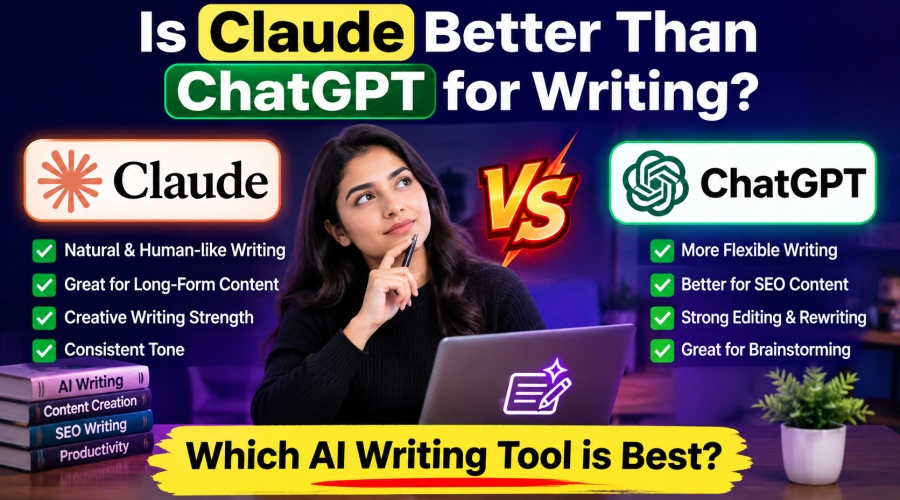
If you’re wondering, “Is Claude better than ChatGPT for writing?”, the answer really depends on what you need. In 2026, both are excellent AI writing tools, but they have different strengths. Claude can be a great option when you want writing that feels natural, polished, and engaging, especially for long-form or creative content. ChatGPT, on the other hand, is a more flexible all-rounder, making it useful for blog posts, SEO content, copywriting, brainstorming, editing, and content planning. Ultimately, the best choice comes down to your writing style and the type of content you’re creating.
When comparing Claude vs ChatGPT for writing, there is no single winner for everyone. The right choice depends on your writing goals, preferred style, and the type of content you create. This comparison looks at their writing quality, naturalness, long-form capabilities, editing, creative writing, SEO content, and overall usefulness to help you choose the best AI writing tool for your needs.
Claude vs ChatGPT for Writing: Quick Answer
If you’re comparing Claude vs ChatGPT for writing, there isn’t one clear winner. Claude can be a better fit for natural-sounding, creative, and long-form writing, while ChatGPT stands out for its flexibility, brainstorming, SEO content, editing, and overall writing workflow.
For simple, polished prose, you may prefer Claude. If you want an AI that can help with everything from generating ideas to structuring, writing, and improving content, ChatGPT is a strong choice. The best AI writing tool ultimately depends on what you’re writing and how you prefer to work.
Claude vs ChatGPT Writing Quality
When comparing Claude vs ChatGPT writing quality, both are powerful AI writing tools, but each has its own strengths. The better option depends on the type of content you create and the writing experience you prefer.
Claude Writing Quality
- Natural tone: Often produces writing that feels conversational and less robotic.
- Long-form content: Strong at maintaining flow and consistency across longer articles.
- Creative writing: Useful for storytelling, character development, and descriptive content.
- Consistent voice: Can maintain a specific tone and writing style throughout a document.
- Polished drafts: Often requires fewer major changes when you want smooth, readable prose.
- Rewriting: Effective for making existing content clearer, more engaging, and natural.
ChatGPT Writing Quality
- Versatile writing: Can handle blogs, emails, product descriptions, scripts, social posts, and business content.
- Multiple writing styles: Easily adapts between professional, casual, persuasive, technical, and conversational tones.
- Content planning: Useful for creating outlines, topic ideas, headlines, FAQs, and content briefs.
- SEO writing: Helpful for building keyword-focused outlines and optimizing content structure.
- Editing: Can improve grammar, clarity, readability, structure, and tone.
- Content variations: Makes it easy to create multiple versions of headlines, introductions, CTAs, and marketing copy.
Which Has Better Writing Quality
When it comes to natural, long-form writing, Claude may have a slight edge because its writing often feels smooth, cohesive, and conversational. For creative writing, Claude is also a strong choice, especially when you want engaging storytelling and a consistent tone. ChatGPT, however, stands out for SEO and structured content, making it useful for creating well-organized articles, outlines, and content strategies. It is also a strong option for brainstorming, helping you quickly develop ideas, headlines, and different content angles. For editing and rewriting, both tools perform well and can improve clarity, tone, grammar, and readability. Overall, if you want an all-around writing assistant, ChatGPT offers broader flexibility, while Claude can be particularly appealing when your main focus is natural and polished writing.
Claude vs ChatGPT for Long-Form Writing
When comparing Claude vs ChatGPT for long-form writing, both are capable of creating detailed articles, guides, reports, essays, and other lengthy content. However, they have different strengths when it comes to producing content that remains clear, engaging, and consistent from beginning to end.
Claude can be particularly appealing for long-form writing because its output often feels natural and cohesive. It is a strong option when you want to develop detailed articles, storytelling, guides, or other content where maintaining a consistent tone and smooth flow is important.
ChatGPT is highly versatile for the complete long-form content workflow. It can help you research ideas, build an outline, organize headings, create drafts, improve individual sections, optimize content for SEO, and rewrite the final piece for a specific audience.
Which Is Better for Long-Form Writing
For natural, flowing prose and creative long-form content, Claude may be the better choice. For a complete content workflow involving planning, SEO, editing, and multiple revisions, ChatGPT can offer greater flexibility.
Ultimately, the best choice depends on your writing goals. If you’re creating professional long-form content regularly, testing the same detailed brief in both tools is often the best way to see which one matches your preferred writing style.
Claude vs ChatGPT for Blog Writing
When comparing Claude vs ChatGPT for blog writing, both can help you create high-quality articles, but they are useful in slightly different ways. The right choice depends on whether your priority is natural writing, SEO, content planning, or having a complete workflow from idea to published article.
Claude is a strong option for bloggers who want natural, engaging, and easy-to-read content. It can help turn a detailed brief into a well-structured article while keeping the tone consistent throughout. This makes it particularly useful for long-form blog posts, tutorials, opinion pieces, and storytelling-based content.
ChatGPT offers a broader blogging workflow. You can use it to generate blog ideas, keyword clusters, outlines, introductions, headings, FAQs, meta descriptions, SEO suggestions, and complete drafts. It is also useful when you want to create multiple versions of a headline or rewrite sections for different audiences.
Which Is Better for Blog Writing
If your main goal is natural, polished blog content, Claude may be the better fit. If you want an all-in-one tool for planning, writing, editing, and SEO-focused blogging, ChatGPT offers more flexibility.
For serious bloggers, the best approach is not to rely entirely on either AI. Use AI to speed up the writing process, then add your own experience, examples, opinions, original insights, and fact-checking. That’s what turns an AI-generated draft into genuinely useful content.
Claude vs ChatGPT for Copywriting
When comparing Claude vs ChatGPT for copywriting, both can create persuasive marketing content, but they have different strengths. Your choice largely depends on whether you need polished brand messaging, creative ideas, or a faster way to produce multiple copy variations.
Claude is well suited for copy that needs to feel natural, thoughtful, and aligned with a specific brand voice. It can be useful for website copy, landing pages, product descriptions, email campaigns, and storytelling-based marketing. With a detailed brand brief, Claude can maintain a consistent tone while making the copy feel less formulaic.
ChatGPT is particularly useful when you need speed, flexibility, and lots of creative variations. You can use it to generate headlines, ad copy, CTAs, product descriptions, email subject lines, social media copy, and different marketing angles. It also makes it easy to test multiple versions for different audiences.
Which Is Better for Copywriting
If your priority is natural, brand-focused, and polished copy, Claude may be a strong choice. If you need multiple ideas, variations, marketing angles, and a flexible copywriting workflow, ChatGPT may be the better option.
Ultimately, great copywriting isn’t just about which AI generates the best sentences. The strongest results come from giving the AI a clear target audience, brand voice, customer pain points, unique selling proposition, and desired action, then refining the output with human judgment.
Claude vs ChatGPT for Editing
When comparing Claude vs ChatGPT for editing, both tools can help improve writing without requiring you to rewrite everything from scratch. They can fix grammar, improve clarity, adjust tone, remove repetition, and make awkward sentences easier to read. The main difference is how they fit into your overall editing workflow.
Claude is a strong option when you want to preserve the original voice of your writing while making it smoother and more natural. It can be particularly useful for long-form articles, essays, reports, creative writing, and detailed documents where maintaining consistency matters.
ChatGPT offers a more flexible editing experience. You can ask it to correct grammar, simplify complicated language, make content more professional, improve readability, shorten paragraphs, or rewrite content for a specific audience. It can also help with SEO editing, headlines, introductions, meta descriptions, and content structure.
Which Is Better for Editing
If you want natural, polished editing while preserving your original voice, Claude may be a great choice. If you need more control over the editing process and want to optimize content for different purposes, ChatGPT offers greater flexibility.
Ultimately, neither tool should automatically replace your final review. The best editing workflow is to use AI for suggestions and improvements, then make the final decisions yourself to ensure the content still sounds like you.
Claude vs ChatGPT for Creative Writing
When comparing Claude vs ChatGPT for creative writing, both AI tools can help writers develop ideas, characters, dialogue, stories, and different writing styles. However, they can feel different when it comes to creativity, storytelling, and maintaining a consistent narrative voice.
Claude is often a strong choice for writers who want natural, expressive, and emotionally engaging prose. It can be useful for developing short stories, character-driven narratives, dialogue, fiction, and descriptive scenes. Its ability to maintain a consistent tone can also make it helpful when working on longer creative projects.
ChatGPT is a versatile creative writing partner that can help you brainstorm story ideas, develop characters, create plot outlines, experiment with genres, and rewrite scenes from different perspectives. It is particularly useful when you want to explore several creative directions quickly.
Which Is Better for Creative Writing
If your priority is natural storytelling, character development, and polished prose, Claude may have an advantage. If you want rapid brainstorming, different creative approaches, and greater control over story structure, ChatGPT can be an excellent choice.
Ultimately, the best AI for creative writing depends on your personal style. A good approach is to use AI as a creative partner rather than a replacement for your imagination—let it help you explore ideas, then add your own experiences, emotions, and unique perspective to make the story truly yours.
Claude vs ChatGPT for SEO Writing
When comparing Claude vs ChatGPT for SEO writing, both can help create useful, well-structured content, but they are strongest in different parts of the SEO workflow. Neither tool should be treated as a replacement for proper keyword research, search-intent analysis, or human expertise.
Claude can be a strong choice for creating natural, readable SEO content. It is useful for turning a detailed content brief into long-form articles, guides, comparison posts, and informational content while keeping the writing clear and consistent. This can be especially valuable when your priority is creating content that readers actually enjoy.
ChatGPT offers a broader SEO content workflow. You can use it to develop keyword clusters, search-intent ideas, content outlines, title tags, meta descriptions, FAQs, internal-linking suggestions, and article drafts. It can also help you reorganize existing content and identify areas that may need better coverage.
Which Is Better for SEO Writing
If your priority is natural, reader-focused content, Claude may be a strong option. If you want an all-in-one AI workflow for planning, structuring, writing, and optimizing SEO content, ChatGPT offers greater flexibility.
However, good SEO is about much more than adding keywords. The strongest content should satisfy search intent, provide original value, demonstrate expertise, and answer the reader’s questions better than competing pages. Use AI to accelerate your SEO workflow, but rely on real keyword data, competitor research, and human judgment to make the final content competitive.
Claude vs ChatGPT for Academic Writing
When comparing Claude vs ChatGPT for academic writing, both can be useful for students, researchers, and professionals who need help organizing ideas, improving clarity, and refining their writing. However, the best choice depends on whether you need help with drafting, editing, research organization, or explaining complex topics.
Claude can be useful for essays, research papers, literature reviews, and long-form academic content where clear structure and consistent writing are important. It can help refine paragraphs, improve transitions, simplify complicated explanations, and make an existing draft more readable while keeping the original meaning.
ChatGPT offers a broader academic writing workflow. It can help with brainstorming research questions, creating outlines, explaining difficult concepts, improving grammar, rewriting paragraphs, summarizing provided material, and organizing ideas. It can also adapt explanations to different levels, from beginner-friendly to highly technical.
Which Is Better for Academic Writing
If your main goal is polishing long-form academic writing and improving flow, Claude may be a strong choice. If you need a versatile study and writing assistant for brainstorming, outlining, explanations, editing, and revisions, ChatGPT may be more useful.
However, AI should support—not replace—your academic work. Always verify facts, citations, statistics, quotations, and references, and follow your institution’s rules regarding AI use. The strongest academic writing combines AI-assisted editing with your own research, critical thinking, and original analysis.
Claude vs ChatGPT: Which Is Better for Writing
When asking “Claude vs ChatGPT, which is better for writing?”, there isn’t a single answer that works for everyone. Both are powerful AI writing tools, but they excel at different types of writing. The better choice depends on what you’re creating, how much editing you’re willing to do, and whether you need a simple writing assistant or a complete content workflow.
Claude can be a great choice for writers who care about natural-sounding, polished, and engaging content. It performs particularly well for long-form articles, creative writing, storytelling, and rewriting where maintaining a consistent voice is important.
ChatGPT is a strong all-around option for people who need more than just writing. It can help with brainstorming, blog writing, SEO content, copywriting, editing, outlines, content planning, and multiple writing variations. This makes it especially useful for bloggers, marketers, businesses, and content teams.
Quick Verdict
- Natural and polished writing: Claude
- Long-form content: Claude
- Creative writing: Claude
- Blog and SEO workflow: ChatGPT
- Brainstorming and content ideas: ChatGPT
- Editing and rewriting: Both
- Copywriting variations: ChatGPT
- All-around writing assistant: ChatGPT
Which AI Writes More Naturally?
If you’re asking which AI writes more naturally, Claude or ChatGPT, the answer depends on the type of content and the prompt you use. Both can produce human-like writing, but their writing styles can feel noticeably different.
Claude is often preferred when the goal is natural, conversational, and polished writing. Its responses can feel less formulaic, especially when writing long-form articles, stories, essays, or content that needs a consistent voice. It can also do a good job of preserving the personality of an existing piece of writing when rewriting it.
ChatGPT can also produce very natural content, particularly when you provide clear instructions about the audience, tone, and writing style. Its biggest advantage is flexibility—you can quickly switch between professional, casual, persuasive, technical, or conversational styles.
Which One Sounds More Human
For natural long-form prose and conversational writing, Claude may have a slight edge. For style flexibility, content variations, and controlled writing, ChatGPT is a strong alternative.
The important thing to remember is that the prompt matters as much as the AI model. A detailed prompt with a clear audience, real-world context, specific tone, and examples will usually produce more natural results than a generic instruction such as “write an article about AI.”
Bottom line: If your top priority is writing that feels natural and human, Claude is worth trying first. If you want natural writing combined with greater control and versatility, ChatGPT is an excellent choice.
Best AI Writing Tool
Choosing the best AI writing tool depends on what you want to create. There is no single tool that is perfect for every writer, but Claude and ChatGPT are two of the strongest options for different writing needs.
Claude is a great choice if your priority is natural, polished, and engaging writing. It can be particularly useful for long-form articles, creative writing, storytelling, and rewriting content while maintaining a consistent voice.
ChatGPT is a strong all-around AI writing tool for people who need more flexibility. It can help with blog posts, SEO content, copywriting, brainstorming, editing, outlines, content planning, and generating multiple versions of the same idea.
Quick Comparison
- Best for natural writing: Claude
- Best free AI APIs: Claude
- Best for long-form content: Claude
- Best for creative writing: Claude
- Best for SEO workflows: ChatGPT
- Best for brainstorming: ChatGPT
- Best for copywriting variations: ChatGPT
- Best for editing: Both
- Best all-around AI writing tool: ChatGPT
Ultimately, the best AI writing tool is the one that fits your workflow and produces content you can confidently refine and publish. For the best results, use AI to speed up your process while adding your own expertise, examples, opinions, and fact-checking.
Claude vs ChatGPT for Content Writing
When comparing Claude vs ChatGPT for content writing, both are capable of creating articles, blog posts, website content, marketing materials, and other forms of digital content. The main difference is how each tool approaches the writing process and what you need from your AI assistant.
Claude is a strong option for writers who want natural, polished, and engaging content. It can be especially useful for long-form articles, guides, storytelling, and content where maintaining a consistent tone and smooth flow is important. Its writing can feel conversational, which makes it a good fit for audience-focused content.
ChatGPT offers a more flexible content-writing workflow. It can help you move from topic research and keyword ideas to outlines, drafts, SEO optimization, editing, FAQs, and content variations. This makes it useful for bloggers, marketers, businesses, and publishers who need to produce different types of content regularly.
Claude vs ChatGPT for Essays
When comparing Claude vs ChatGPT for essays, both AI tools can help with brainstorming, outlining, drafting, editing, and improving the overall quality of an essay. However, they have different strengths depending on whether you need help developing ideas or polishing the final piece.
Claude can be a strong choice for writing essays that need a natural flow, clear arguments, and consistent tone. It can help turn your ideas into well-connected paragraphs, improve transitions, and make writing feel less repetitive. This can be particularly useful for argumentative, analytical, and reflective essays.
ChatGPT offers a broader essay-writing workflow. You can use it to brainstorm topics, develop thesis statements, create outlines, explain difficult concepts, improve paragraphs, check grammar, and rewrite sections for a specific audience or academic level. It can also help you explore different approaches before settling on a final structure.
Claude vs ChatGPT for Business Writing
When comparing Claude vs ChatGPT for business writing, both AI tools can help professionals create clear, polished, and professional content. Whether you’re writing emails, reports, proposals, presentations, or business documents, the better choice depends on your specific workflow and communication needs.
Claude can be particularly useful when you want business content that feels natural, professional, and thoughtfully written. It works well for detailed reports, proposals, internal documents, client communications, and long-form business content where maintaining a consistent tone is important.
ChatGPT offers a more flexible business-writing workflow. It can help create professional emails, reports, proposals, meeting summaries, presentations, marketing copy, business plans, and content variations. You can also quickly adjust the tone—for example, making a message more formal, concise, persuasive, friendly, or executive-focused.
At the end of the day, Claude vs ChatGPT for writing isn’t really about finding one universal winner. It’s about finding the tool that works best for the way you write. Claude can be a great choice when you want content that feels natural, polished, and engaging, particularly for long-form and creative projects. ChatGPT, meanwhile, gives you more flexibility when you need help with blogging, SEO, brainstorming, copywriting, editing, and overall content planning. If you’re still unsure, try giving both tools the same prompt and compare the results. Look at the tone, clarity, structure, originality, and amount of editing required. In the end, the best AI writing tool is the one that helps you create useful content while still leaving room for your own experience, ideas, and voice.
Frequently Asked Questions (FAQs)
Is Claude better than ChatGPT for writing?
It really depends on what you’re trying to write. Claude can be a great choice if you want natural, polished, and engaging content, especially for long-form or creative writing. ChatGPT is more flexible and can help with everything from brainstorming and blog writing to SEO, editing, and content planning.
Which AI writes more naturally?
Both can produce natural-sounding content, but Claude may have a slight edge when you want writing that feels conversational and consistent. ChatGPT can also sound very natural when you give it clear instructions about your audience, tone, and preferred style.
Is Claude better for long-form writing?
Claude can be a good fit for long articles, guides, essays, and creative projects because it can maintain a smooth and consistent writing style. ChatGPT is particularly useful when your long-form workflow also involves planning, SEO, editing, and multiple revisions.
Which is better for SEO writing?
ChatGPT can be especially useful for the broader SEO process, including keyword clusters, outlines, FAQs, meta descriptions, and content planning. Claude is also a strong option when your main goal is creating natural, easy-to-read SEO content.
Which AI is better for creative writing?
Claude may appeal to writers who want natural storytelling, expressive prose, and consistent character or narrative voices. ChatGPT is useful when you want to brainstorm quickly, explore different story ideas, or experiment with different genres and approaches.
Can Claude and ChatGPT edit and rewrite content?
Yes. Both can help fix grammar, improve clarity, remove repetition, and adjust tone. Claude can be useful when you want to keep the original voice of your writing, while ChatGPT gives you plenty of control over how the content should be rewritten.
Which is the best AI writing tool in 2026?
There isn’t one tool that’s perfect for everyone. Claude may be the better fit for natural and polished writing, while ChatGPT is a strong all-around option for writing, SEO, brainstorming, editing, and content planning.